 Book now
 Basic or Extended tour of Villa Tugendhat: which should you book?
Both tours show the living floor and the onyx wall, but only the Extended tour runs in English and opens the machine rooms below it.
Book the Extended tour if you want a guide speaking English, or if you care how the house worked: it runs 90 minutes and adds the technical floor, with the air system, the boiler room, the window machinery, the laundry, the darkroom and the moth room. Book the Basic tour if 60 minutes in the main rooms is enough and you are happy to follow a Czech-led tour with the villa's printed English text or its phone audio guide. Both tours walk the same rooms upstairs: the bedroom floor and upper terrace, then down to the living floor with the onyx wall, the dining curve and the two windows that sink into the floor. Groups are capped at 16 people, and dates sell out.
What is the difference between the Basic and the Extended tour?
Both tours are guided, and both are capped at 16 people per group. The Basic tour lasts 60 minutes. The villa's operator, the Brno City Museum, describes it as presenting the highlights of the entire building. The Extended tour lasts 90 minutes and covers the entire building including the technical facilities.
The shared route runs from the top of the house to the bottom. You start on the bedroom floor at street level, with the upper terrace, the entrance hall, the parents' section and the children's section. You then go down to the main living floor, with the living area, the preparation room and the kitchen. The garden follows if the weather allows, and both tours include the exhibitions on the technical floor.
Only the Extended tour opens the six technical rooms: the air-conditioning machinery room, the boiler room, the machine room for the electric windows, the laundry, Fritz Tugendhat's photo darkroom and the fur-coat safe the family called the moth room. The museum says it sees huge interest in the Extended tours. It is also the version that runs in English on the public timetable.
Which tour runs in English?
On the villa's public timetable, the English tours are Extended tours. They normally run at 12:00 and 15:00, Tuesday to Sunday. The villa is closed on Mondays. If you want a guide speaking English to you for the whole visit, those two daily slots are your options.
Basic tours are led in Czech. That does not leave you lost. During tours the villa hands out a short printed guide in English, German, Italian, Spanish, French, Russian and Japanese. It also offers an audio guide that you download to your own phone through a QR code, in 12 languages including English.
The trade-off is simple. On a Basic tour you read or listen at your own pace while the guide's commentary, and the group's questions, are in Czech. For many English speakers that alone settles the choice in favour of the Extended tour, before the technical floor even comes into it.
What do you see on the bedroom floor and the upper terrace?
You enter from Černopolní street at the top of the house. The villa sits on a slope facing south-west, and the bedroom floor is the highest of its three storeys. From the street the house shows a stern, closed face.
The entrance hall floor and the staircases are Italian travertine from Tivoli, almost white. The hall walls, the doors and the built-in cupboards in the parents' rooms are veneered in palisander. The children's rooms use zebra veneer. Here the tour shows the parents' section and the children's section, where Fritz and Grete Tugendhat raised Hana, Ernst and Herbert until the family left Brno in 1938.
The upper terrace runs alongside these rooms, with a view over the historic city centre and the villa colony above Lužánky Park. Its semicircular bench came about after Mies and Lilly Reich visited Charlottenhof Palace, according to their collaborator Sergius Ruegenberg. At night an electric eye guarded the way from the street to the terrace, so the family could leave the bedroom doors onto the terrace open. Then you go down the travertine stairs. The house is designed so that you reach its main space by descending into it.
What do you see on the main living floor and in the garden?
The main living floor is one large open space. Look first at what holds it up: slender steel columns with a cross-shaped profile, set about five metres apart and clad in brass that is chrome-plated to a bright shine. Grete recalled seeing small crosses on the first plan and asking what they were. Mies told her they were iron supports which hold up the entire structure.
The onyx wall divides the seating area from the study behind it. The stone is honey-coloured with white veins, quarried in the Atlas Mountains of what was then French Morocco, and strictly speaking it is aragonite. Mies found the block in Hamburg, where it was meant for two vases on a luxury steamer. The stone is translucent: when the low sun strikes it, some veins on the far side glow red. Behind it sit the library, whose built-in shelving survived the war, and the winter garden, which held a rectangular pond and Fritz's flowering plants.
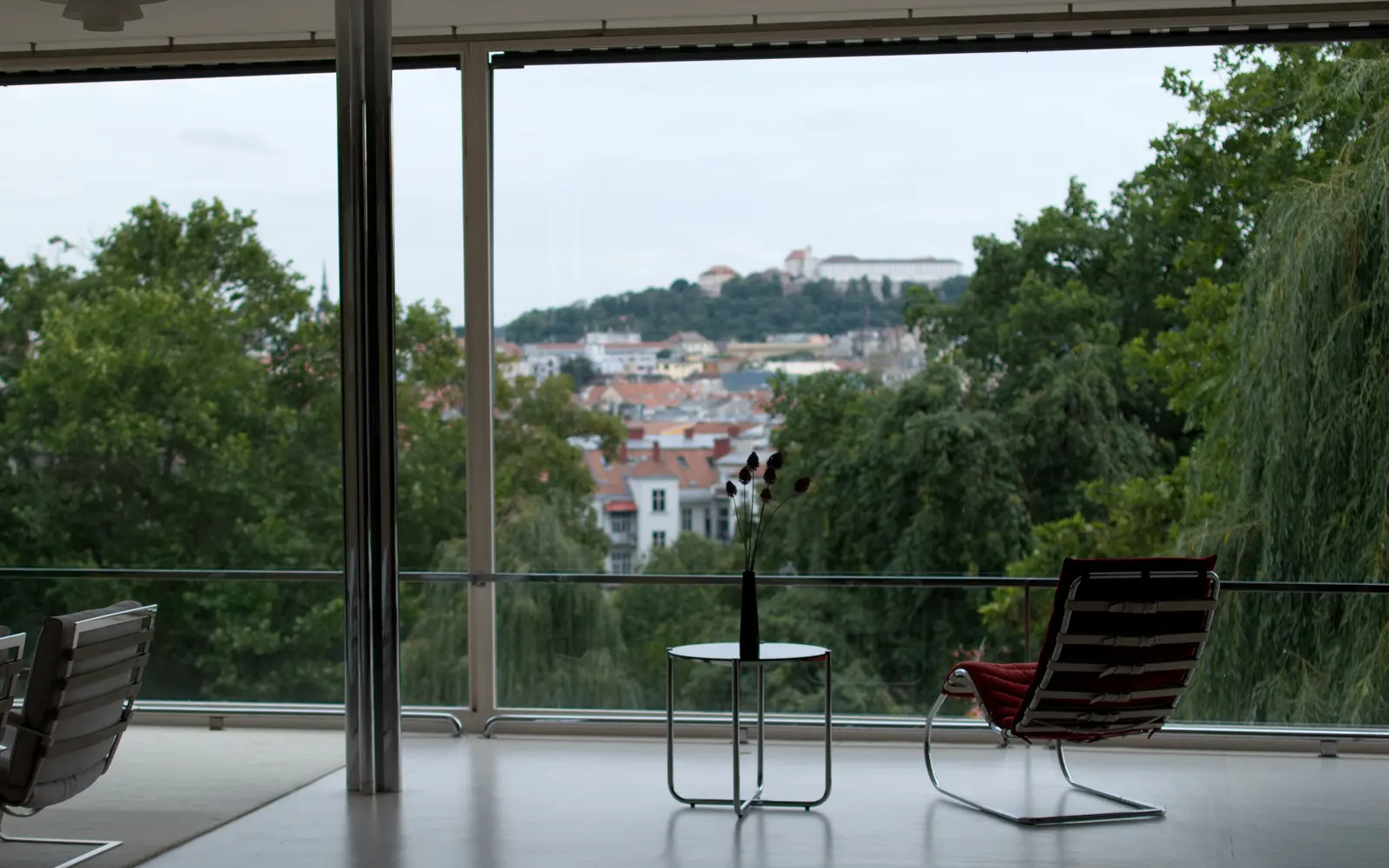
Across the room, a half-circle of wall wraps the dining area. Mies chose Macassar ebony veneer for it in Paris, because there he found sheets long enough to run from floor to ceiling. The original curve was gone by the autumn of 1940, and parts of the original wood panelling later turned up at Masaryk University. Opposite the onyx wall and the dining area are the two great windows that electric motors lowered all the way into the floor, opening the room to the garden.
Lilly Reich supervised every material and every textile colour on this floor. Look for the Tugendhat armchairs, the Barcelona chairs in emerald leather and the Brno chairs in white sheepskin; the rooms are furnished with exact replicas made for the restoration of 2010 to 2012. Both tours then cross to the service side of this floor, the kitchen and the preparation room. If the weather allows, you go out into the garden, an English-style park where Mies kept the old paths and a weeping willow, and where the garden architect Markéta Roderová-Müllerová laid out broad lawns with isolated trees.
What is on the technical floor, and why do architects choose the Extended tour?
The technical floor is the lowest of the three storeys. Both tours visit the exhibition down here, which covers the architect, the owners and family life in the villa up to 1938. Only the Extended tour takes you through the working rooms the museum restored as part of the house. The museum's history calls the house's utility and technical equipment completely innovative for the time. That is why architects, engineers and building-services specialists book the Extended tour: the open plan upstairs only works because of what is down here.
Start with the air-conditioning machinery room. Mies did not want heating fittings to break up the big living space, so the house got an air system that combined heating, cooling and humidification, and served as air conditioning in summer. Few private homes had such a system in 1930, yet Grete said it worked perfectly: “The entire space would be warm only half an hour after opening it.” When the house was restored in 1981 to 1985, this room was found practically in its original state. The boiler room ran on coke, kept in its own stores; in the 1980s it was converted into a calorifier room linked to an outdoor heat pipe.
The window machine rooms explain the trick you saw upstairs. The two big panes did not slide aside: motors lowered them into the floor, much like a car window. By the end of the war the motors for the windows and for the air machinery were missing, and the boiler was damaged. The restorers of 1981 to 1985 kept the original supporting structure in both engine rooms and fitted new drive units.
The remaining rooms show the household. The laundry belonged to a run of wash, drying and ironing rooms. Fritz Tugendhat was a passionate photographer and amateur film-maker, and he had his own darkroom here; his photographs of family life show the house as a home rather than a piece of architecture. The moth room, Mottenkammer in German, was a dedicated moth-resistant store for the family's fur coats.
Who should book the Basic tour, and who should not?
The Basic tour suits you if the living room is what you came for. It covers the onyx wall, the dining curve, the chrome columns, the lowering windows and the bedroom floor. It suits a tight day, because 60 minutes leaves more time for Villa Löw-Beer next door, Grete's parents' house. And it is a sensible fallback when both English Extended slots on your date are full.
It does not suit you if you need a guide in English. It does not suit architects, engineers or students of building technology either: you hear about the air system and the motorised windows upstairs, then leave without seeing the machines. If you find it hard to read printed text while walking, or dislike audio guides, the Czech commentary will feel like background noise for an hour.
Who should book the Extended tour, and who should not?
The Extended tour suits English speakers almost by default, because it holds both English slots. It suits architects, engineers, design students and anyone who reads a building by how it works. It also suits people who want the family story in full: the darkroom and the moth room say as much about how the Tugendhats lived as the living room does.
It does not suit small children. Ninety minutes on a guided tour is a long time for a five-year-old. Children under 6 go free on your booking, and the family fare covers two adults with one or two children under 15, but a free place does not make the tour shorter. With young children, the 60-minute Basic tour is the kinder choice.
It also does not suit you if you only have eyes for the living room. The Basic tour already covers it in full. The extra half hour is spent among machinery and storerooms.
What should you know before tour day, whichever tour you book?
Your guide meets you at Černopolní 45, by the gate marked MAIN ENTRANCE. The nearest public transport stop is Dětská nemocnice, about ten minutes on foot along Černopolní. There is no visitor parking near the villa, which sits in a resident parking zone.
Stiletto heels are not allowed inside, and neither is bulky luggage; there are lockers for bags before the tour starts. Photography inside needs a separate photo ticket bought at the villa's desk, and even then no flash and no tripod. The operator caps each booking at three groups, and a party of 16 or more counts as a group visit with its own conditions.
Both tours sell out. New dates go on sale in weekly batches on Sunday evenings at 18:00 Brno time, roughly 12 to 13 weeks ahead. The museum warns that tours can sell out within a few moments on the sale opening day, and on 14 October 2026 every Basic and Extended tour was full. You can book with us for any date, including dates not yet released. We place your booking the moment your date opens and email you the e-ticket once it is issued. If the tour you chose has gone, we tell you and offer the tours still open that day.
Choose carefully, because the operator allows no cancellation and no date change once a ticket is bought. A resale scheme exists, but only for fully booked Basic and Extended tours, only until 100 hours before the tour, and a fee is kept.
Frequently asked
Is the Extended tour worth the extra 30 minutes?
Yes, if you want a guide speaking English or care how the house worked. It adds the air-conditioning room, the boiler room, the window machinery, the laundry, the darkroom and the moth room. If only the living room interests you and you are happy with a Czech-led tour, the Basic tour already covers it.
Can I take the Basic tour in English?
Not with an English-speaking guide on the public timetable. Basic tours are led in Czech, and you follow with the villa's printed English guide or its phone audio guide, available in 12 languages through a QR code. The English public tours are Extended tours, normally at 12:00 and 15:00.
Can young children join the Extended tour?
Yes, and children under 6 go free on your booking. The real question is stamina, because 90 minutes is long for small children. The 60-minute Basic tour is the gentler choice for young families. The family fare covers two adults and one or two children under 15.
Can I take photos inside the villa?
Only with a separate photo ticket, bought at the villa's desk on the day. Flash and tripods are not allowed even with it. This applies on both the Basic and the Extended tour.
Can I switch from the Basic to the Extended tour after booking?
No. The operator allows no cancellation or date change once a ticket is bought, so decide before you book. If you are unsure, the Extended tour covers everything the Basic tour does, plus the technical floor.
Can I see the technical floor without a tour?
Partly. During opening hours the garden and the exhibitions on the technical floor are open free of charge without a guide, with the garden closed in snow, ice or wind. The machine rooms, the boiler room, the laundry, the darkroom and the moth room are shown on the Extended tour.